EC grade 99.9% pure copper strips for the most demanding grounding — LV, MV and HV substations and high-voltage electrode networks.
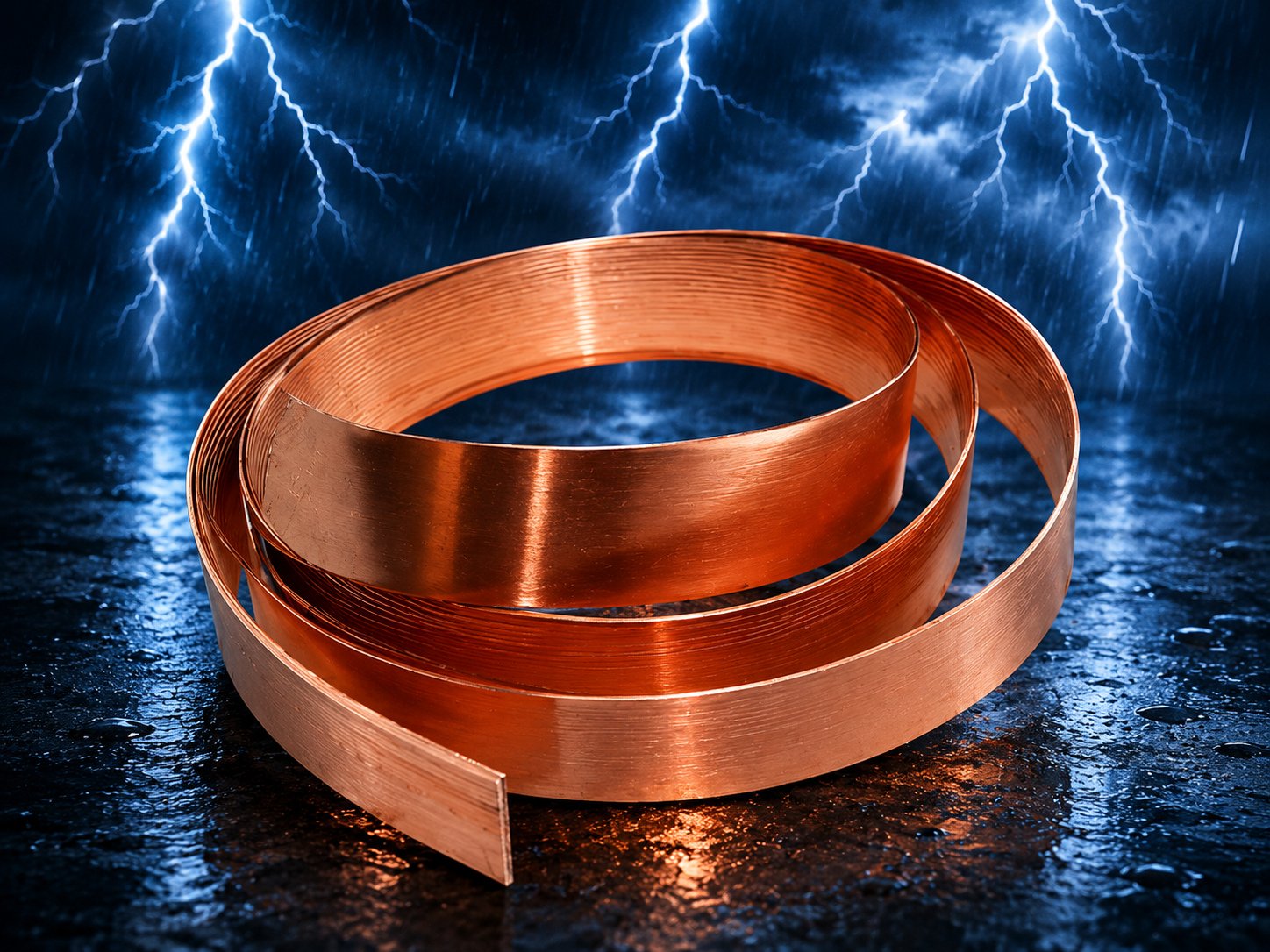
Our copper earthing strips are rolled from EC (Electrolytic Copper) grade material of 99.9% purity, delivering the highest conductivity per section of any earthing conductor. They are the specified choice for substation grounding grids and high-voltage electrode connections.
Supplied in sizes from 25×3 mm up to 100×10 mm, the strips resist corrosion naturally and hold their conductivity for the life of the installation.
| Material | EC grade electrolytic copper, 99.9% purity |
|---|---|
| Size Range | 25×3 mm to 100×10 mm |
| Application | LV / MV / HV substation grounding, HV electrodes |
| Supply | Standard lengths or as per requirement |
| Finish | Bare copper |
When the conductor itself must never be the limiting element — substation grids, lightning down conductors, clean-earth risers for electronics — the specification moves to EC-grade copper. At 99.9% purity, copper strip carries roughly 100% IACS conductivity, meaning smaller sections do more work, joints run cooler, and buried runs outlive the plant around them.
Copper's corrosion story underground is fundamentally different from coated steel: instead of a sacrificial layer that is consumed, copper forms a thin, stable, adherent oxide that passivates the surface. There is no coating to wear through, which is why copper earthing installed decades ago is routinely dug up intact.
Under lightning impulse, the strip's flat geometry and copper's low surface resistivity work together: skin effect concentrates the fast-rising current at the conductor surface, and copper strip presents the lowest impulse impedance of any practical earthing conductor — the reason NFC 17-102 practice defaults to copper for ESE down conductors.
Metal Hub supplies EC-grade strip from 25×3 mm to 100×10 mm, bare-finished, in standard lengths or coils. Every batch is traceable to material certification for project QA files.
Good to know: The premium of copper over GI is largest at purchase and smallest over the life cycle — on a 30-year installation, copper's no-replacement economics usually win.
Every impurity percentage in copper costs conductivity, which is why EC (electrolytic) grade at 99.9% is the specification benchmark. Full conductivity means fault energy converts to less heat in the conductor and its joints — the mechanism behind copper's cool-running reputation on high-fault-level systems.
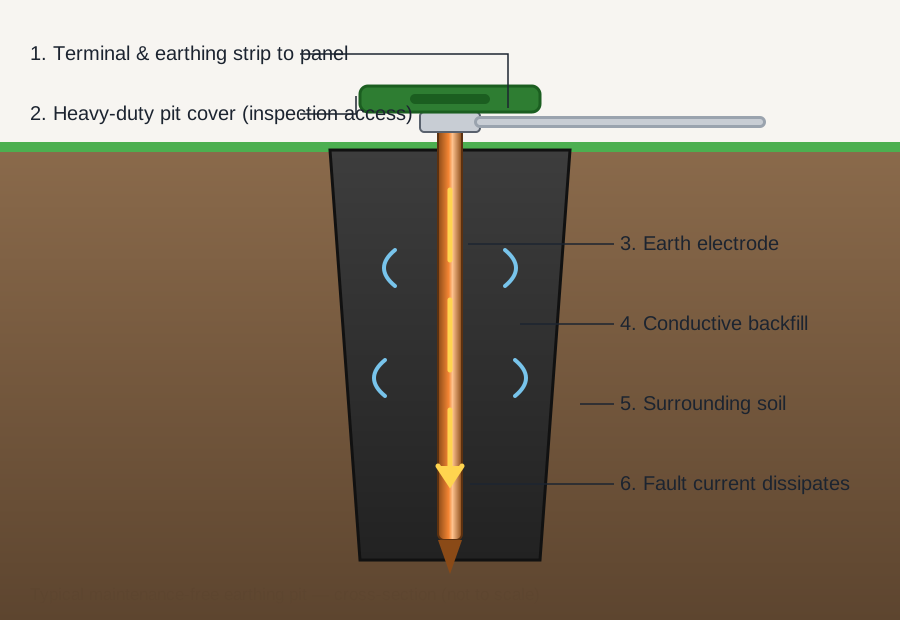
The deeper system benefit is galvanic homogeneity: copper strip, copper-bonded or pure copper electrodes and copper-alloy clamps form a single-metal path below ground with no dissimilar couples to corrode. Mixed-metal earthing systems fail at their interfaces; all-copper systems don't have those interfaces.
Weight basis: copper at 8.89 g/cm³. Standard lengths or coils to order.
| Size (mm) | Cross-section (mm²) | Approx. weight (kg/m) | Typical duty |
|---|---|---|---|
| 25 × 3 | 75 | 0.67 | Clean-earth risers, bonding |
| 25 × 5 | 125 | 1.11 | Lightning down conductors |
| 32 × 5 | 160 | 1.42 | Commercial LPS and HT panels |
| 50 × 5 | 250 | 2.22 | Substation connections |
| 50 × 6 | 300 | 2.67 | Grid tails, transformer earthing |
| 75 × 8 | 600 | 5.33 | Main grid conductors |
| 100 × 10 | 1000 | 8.89 | EHV risers and bus earthing |
| Property | Value | Why it matters |
|---|---|---|
| Grade / purity | EC grade, 99.9% Cu | Benchmark conductivity |
| Conductivity | ≈ 100% IACS | Smallest section per duty |
| Corrosion behaviour | Self-passivating | No coating to consume |
| Finish | Bare | Direct clamping and welding |
| Traceability | Batch material certificates | Project QA documentation |
| Standard | Title / scope | Relevance |
|---|---|---|
| IS 3043 | Code of practice for earthing | Conductor sizing and practice |
| IS 2309 / NFC 17-102 | Lightning protection | Down conductor material requirements |
| IEC 62561-2 | LPS components | Conductor cross-section requirements |
| IS 613 | Copper rods and bars for electrical purposes | Material grade benchmark |
| Application | Recommended size | Why copper |
|---|---|---|
| ESE / lightning down conductor | 25 × 5 mm+ | Lowest impulse impedance |
| Substation earth grid | 50 × 6 to 100 × 10 mm | Fault energy and 40-year life |
| Clean earth for electronics / server rooms | 25 × 3 mm | Stable low-noise reference |
| Transformer neutral earthing | 50 × 5 / 50 × 6 mm | Cool joints at high fault duty |
| Corrosive soil where GI dies early | Per calculation | Passivating chemistry |
| Parameter | Copper strip | GI strip |
|---|---|---|
| Conductivity | ≈ 100% IACS | ≈ 10 – 15% IACS equivalent |
| Buried life | 40+ years | 15+ years at 86 µ coating |
| Impulse behaviour | Best available | Adequate |
| Cost | High | Low |
| Theft risk | High — plan security | Low |
Plan the most direct run; for lightning duty avoid sharp bends — keep bend radii generous to prevent impulse flashover.
Use copper or copper-alloy saddles and fasteners; never steel screws directly onto the strip.
Overlap 50 mm minimum with two bolts, or exothermic-weld for buried and critical joints — the weld is a molecular copper joint that never loosens.
Where aluminium or GI must connect, use bimetallic connectors above grade; keep the below-grade path all-copper.
Sleeve the strip through the soil-air transition and at floor level against mechanical damage.
Record routes on as-builts; where theft risk exists, conceal runs and consider anti-theft clamping at accessible points.
Copper strip is effectively a fit-and-forget conductor: no coating to monitor and no scheduled replacement. Maintenance attention belongs at the joints and at security — bolted joints should be checked for torque and cleanliness on the annual walkdown, and exposed runs verified against tampering or theft.
On lightning systems, pair the strip inspection with the strike counter reading: after any recorded strike, inspect the down conductor's fixings and bends before the next storm season.
Yes for the duty this strip serves. Each purity step below 99.9% costs conductivity and raises joint temperatures at fault; EC grade is the standard benchmark that keeps sections small and joints cool.
Lightning down conductors under NFC 17-102 practice, substation grids per design calculation, clean-earth systems for electronics, and any buried connection to copper electrodes — where galvanic uniformity rules out GI.
Conceal routes where possible, sleeve exposed risers, use tamper-resistant fixings at reachable heights, and photograph installed runs for recovery evidence. We advise on layouts that minimise exposed copper.
Bolted overlap joints are fine for accessible, inspectable locations. For buried or critical joints, exothermic welding creates a permanent molecular connection with no contact resistance to drift over time.
25×3 through 100×10 mm as standard, in lengths or coils. Non-standard sections are rolled against order with material certification.
Only through a bimetallic connector, and only above grade. Direct contact creates a galvanic cell that consumes the zinc on the GI side.
Hot-dip galvanized, minimum 86 micron zinc coating.
View Details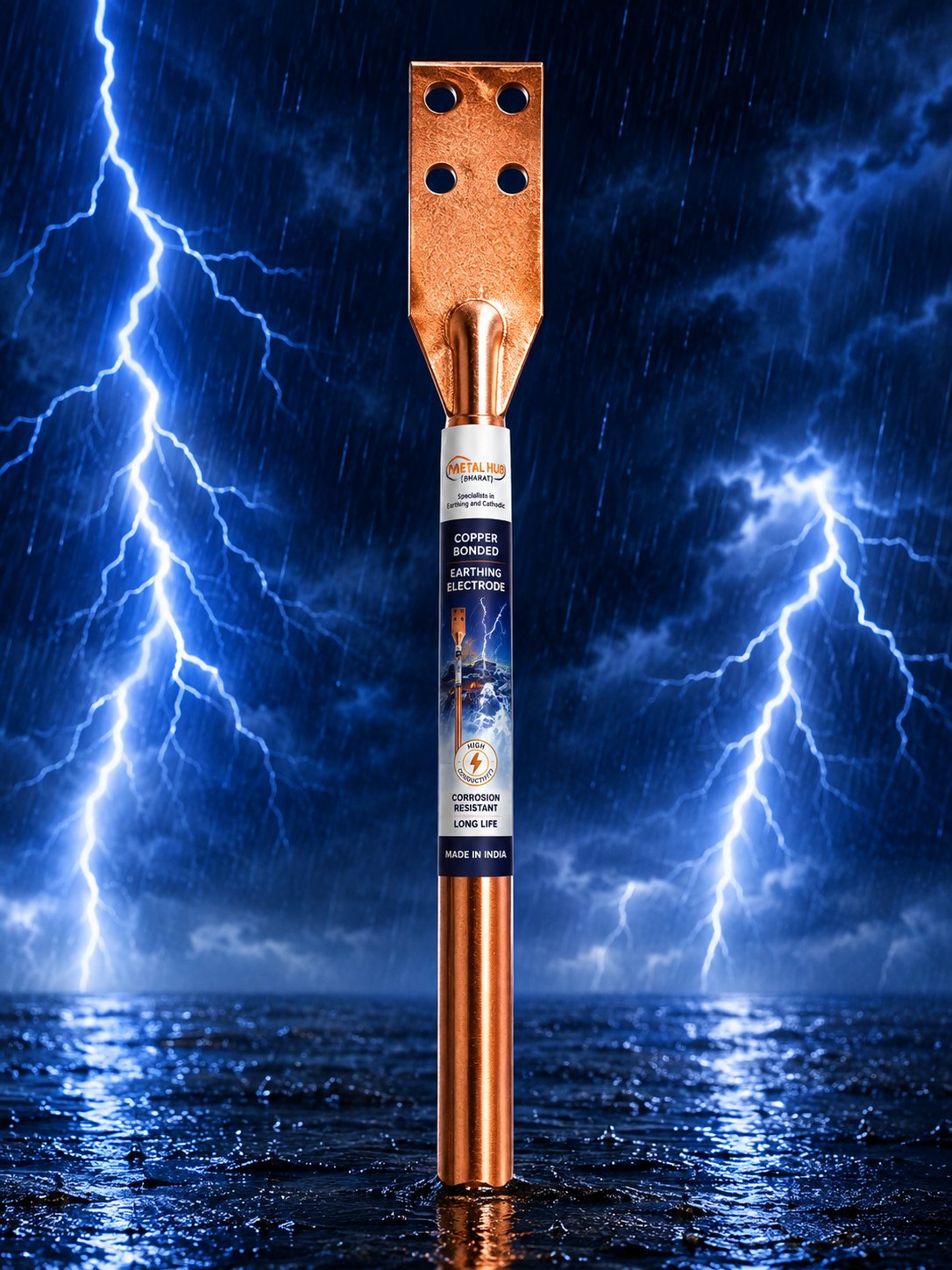
NABL & CPRI lab-tested electrodes with molecularly bonded copper coating.
View Details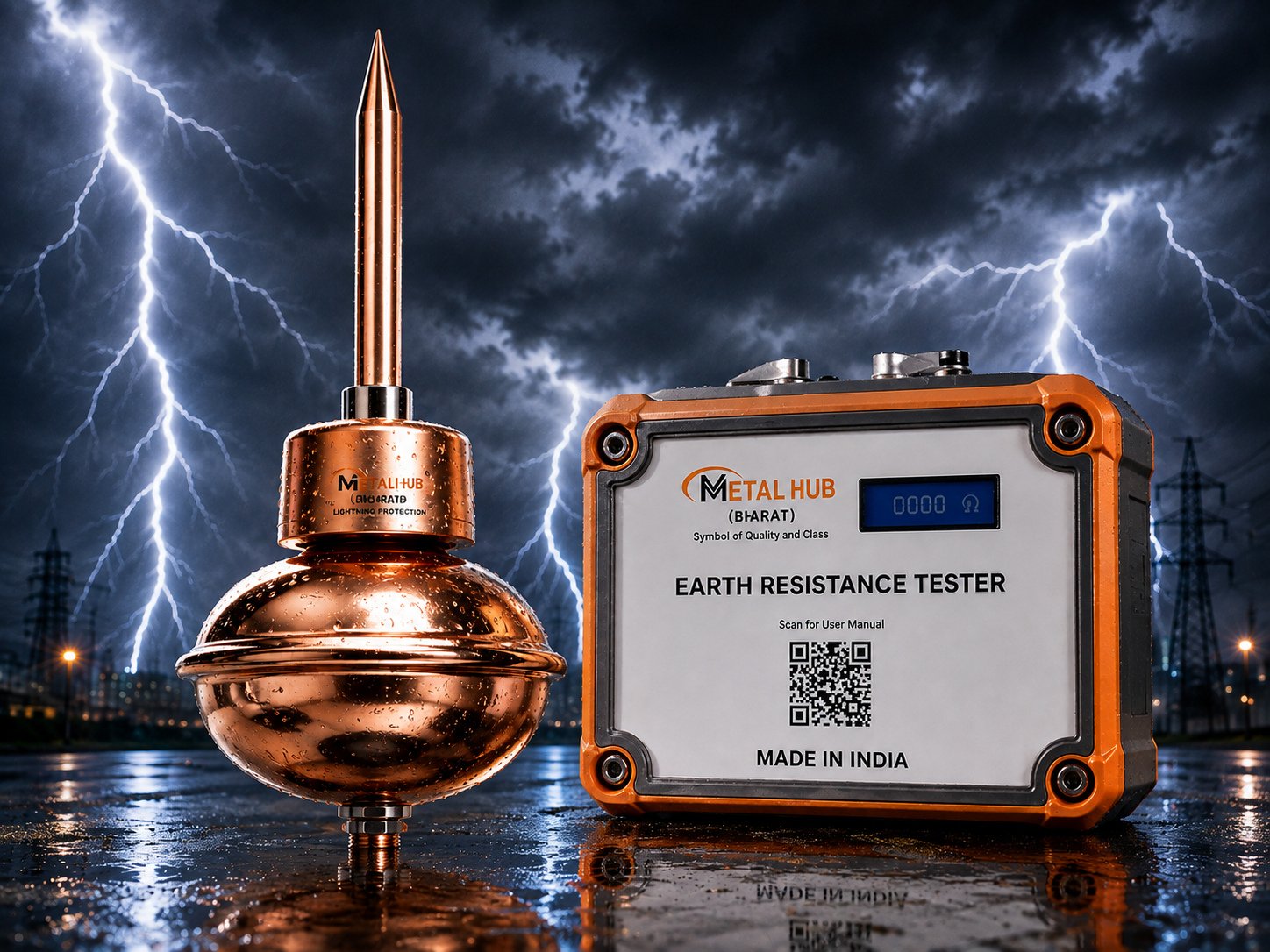
Tested to NFC 17-102 with IP67 digital counters certified at 100kA.
View DetailsShare sizes and quantities — we'll quote the same working day.