Graphite-based ground enhancing compound with resistivity below 0.2 ohm-m — low resistance from day one, with zero watering.
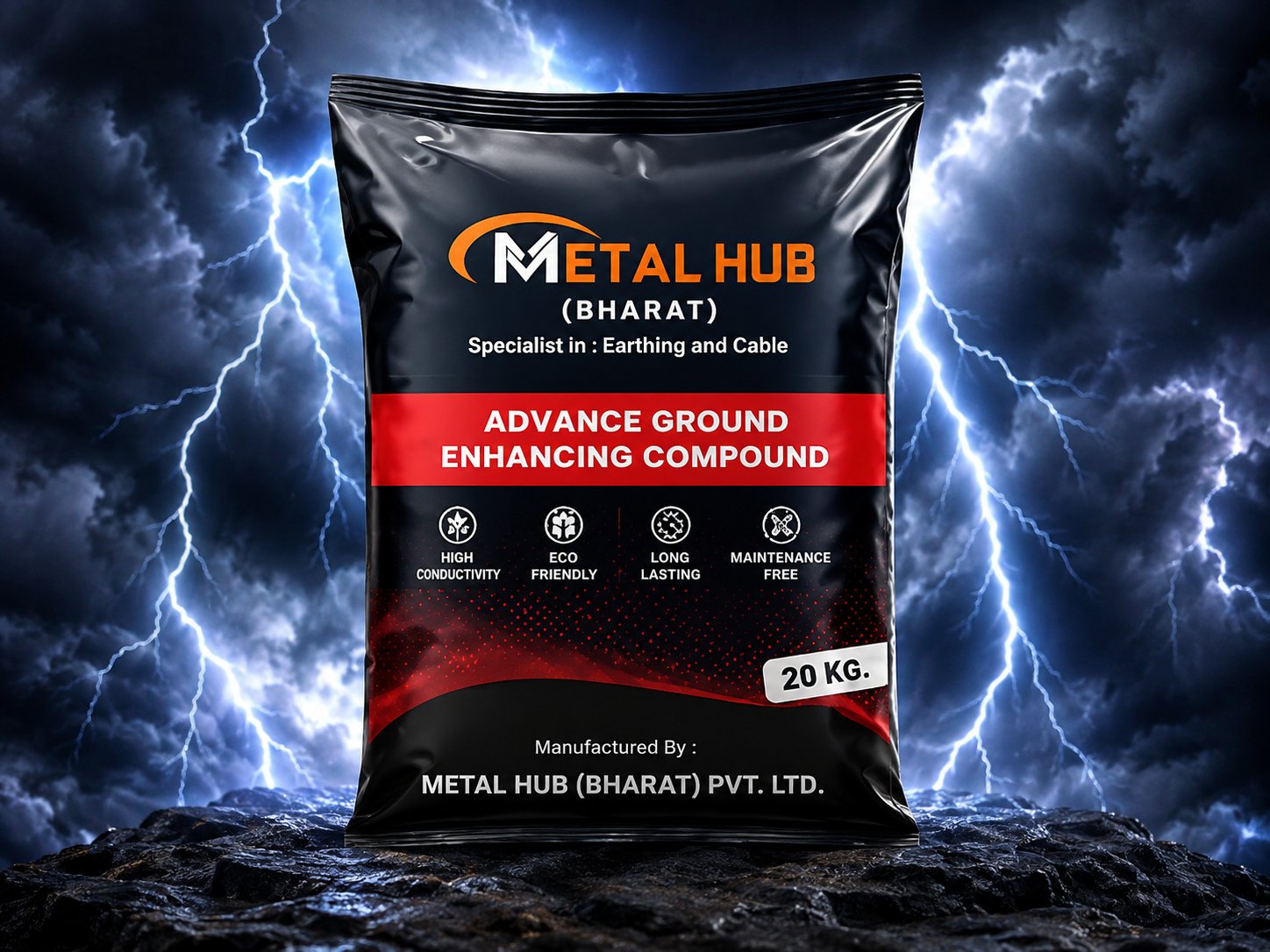
Metal Hub backfill compounds surround the electrode with a highly conductive, moisture-retaining medium that dramatically lowers earth resistance — especially in rocky, sandy or high-resistivity soils. The graphite-based formulation achieves resistivity below 0.2 ohm-m and never needs watering.
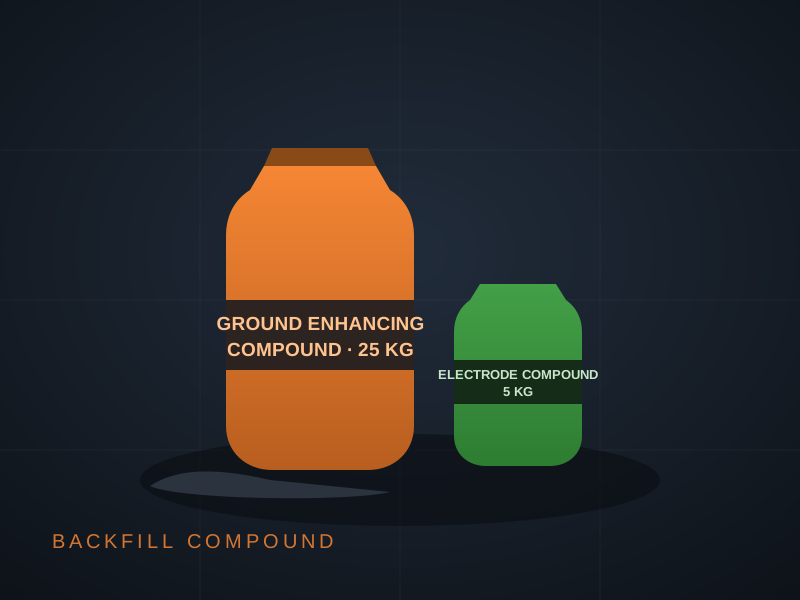
Available as 25 kg Advance Ground Enhancing Compound for full pit installations and 5 kg Earthing Electrode Compound for electrode charging — both non-corrosive to the electrode and stable across seasons.
| Type | Graphite-based conductive ground enhancing compound |
|---|---|
| Resistivity | Below 0.2 ohm-m |
| Pack Sizes | 25 kg (Advance Ground Enhancing Compound), 5 kg (Earthing Electrode Compound) |
| Watering | Not required |
| Effect on Electrode | Non-corrosive |
| Best With | Copper bonded, pure copper and GI electrodes |
Electrode marketing gets the attention, but in high-resistivity soil the backfill compound frequently determines whether the pit meets specification at all. The first few centimetres of material around the electrode carry the entire current transfer into ground; replacing that layer with an engineered conductive medium is the cheapest resistance reduction available in earthing practice.
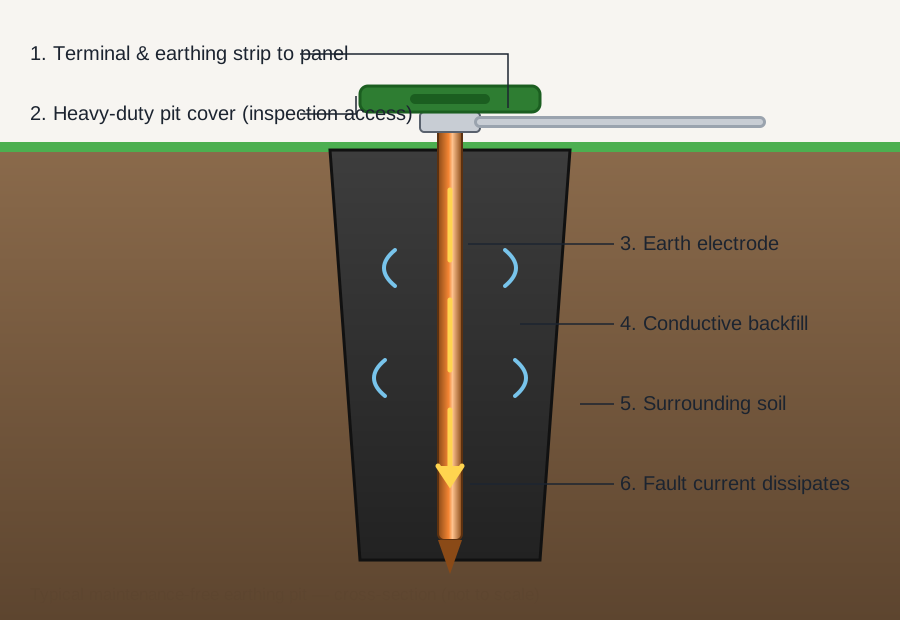
Metal Hub compound is a graphite-based conductive formulation with resistivity below 0.2 ohm-m — several orders of magnitude more conductive than even excellent native soil. It is hygroscopic, drawing and retaining soil moisture around the electrode, and it sets into a stable, frost-and-drought-resistant conductive collar that effectively enlarges the electrode's diameter.
Equally important is what it is not: it is not salt, and it is not corrosive. The traditional salt-charcoal pit lowered resistance temporarily by dissolving salt into groundwater — corroding the electrode, leaching away within seasons, and demanding endless watering. Graphite-based compound is chemically inert toward copper, copper-bonded and galvanized surfaces, and does not wash away.
Two pack formats cover site needs: the 25 kg Advance Ground Enhancing Compound for full-pit installation, and the 5 kg Earthing Electrode Compound for charging and topping up electrode annuli.
Good to know: Compound quantity is calculated per pit, not guessed: a 3 m electrode in a 150 mm bore typically needs two to three 25 kg bags for a void-free column.
First, conduction: graphite provides electronic conductivity that does not depend on dissolved ions, so the collar stays conductive even in dry spells. Second, moisture retention: the hygroscopic matrix holds capillary water drawn from surrounding soil, keeping the electrode-soil interface wet through summer. Third, geometry: the compound column enlarges the effective electrode diameter, and resistance falls as effective diameter grows.
Because all three mechanisms are permanent physical properties rather than consumable chemistry, the resistance improvement is stable across years — the defining difference between an engineered compound and a salt pit.
| Parameter | Value | Notes |
|---|---|---|
| Type | Graphite-based conductive compound | Electronic conduction, not ionic |
| Resistivity | < 0.2 ohm-m | Orders of magnitude below native soil |
| Corrosivity | Non-corrosive to Cu / Cu-bonded / GI | Safe for all Metal Hub electrodes |
| Watering requirement | None | Hygroscopic moisture retention |
| Pack sizes | 25 kg and 5 kg | Full pit / electrode charge |
| Shelf life | Indefinite in sealed bags, stored dry | No consumable chemistry |
Quantities for a void-free column; verify against actual bore diameter on site.
| Installation | Bore / pit size | Typical quantity |
|---|---|---|
| 2 m electrode | 100 – 150 mm bore | 1 – 2 × 25 kg bags |
| 3 m electrode | 150 mm bore | 2 – 3 × 25 kg bags |
| 3 m electrode | 200 mm bore | 3 – 4 × 25 kg bags |
| Strip trench (per metre) | 300 × 300 mm surround | ≈ 10 – 15 kg |
| Electrode annulus top-up | — | 1 × 5 kg bag |
| Parameter | Graphite compound | Bentonite | Salt + charcoal |
|---|---|---|---|
| Resistivity | < 0.2 ohm-m | ≈ 2.5 ohm-m (wet) | Low only while salt persists |
| Performance when dry | Retained (electronic conduction) | Falls sharply — shrinks and cracks | Lost |
| Corrosive to electrode | No | No | Yes — severe |
| Watering needed | No | In dry seasons | Regular |
| Lifespan | Life of the pit | Years, if kept moist | 1 – 3 seasons |
| Standard | Title / scope | Relevance |
|---|---|---|
| IS 3043 | Code of practice for earthing | Recognises soil treatment to reduce resistivity |
| IEC 62561-7 | LPS components — earthing enhancing compounds | Requirements for ground enhancement materials |
| Job | Recommended product | Why |
|---|---|---|
| New electrode pit | 25 kg Advance Compound | Full annulus column in one pour |
| Multiple-pit substation project | 25 kg bags (bulk) | Consistent batch, project economics |
| Recharging an older chemical electrode | 5 kg Electrode Compound | Sized for annulus top-up |
| Strip trench in rocky ground | 25 kg Advance Compound | Surround conductor along run |
Measured improvements vary with soil; these ranges reflect common field experience.
| Native soil | Single 3 m electrode alone | Same electrode + compound |
|---|---|---|
| Moist clay (≈ 50 ohm-m) | ≈ 15 – 20 ohm | ≈ 5 – 8 ohm |
| Clay-sand (≈ 150 ohm-m) | ≈ 45 – 60 ohm | ≈ 12 – 20 ohm |
| Sandy (≈ 400 ohm-m) | ≈ 120 – 160 ohm | ≈ 30 – 50 ohm |
| Rocky (≥ 1000 ohm-m) | Often unmeasurable | Design-dependent; multi-pit |
Bore or excavate to electrode depth; remove loose debris so compound contacts undisturbed soil.
Mix compound with clean water to a thick pourable slurry — a slurry flows into every void that dry powder cannot reach.
Pour around the centred electrode in 3 – 4 stages, rodding gently after each pour to release trapped air.
Bring the column up to about 150 mm below finished level, leaving room for the terminal and cover.
Complete the strip connection, fit the FRP cover and reinstate the surface.
Measure after 48 – 72 hours; the reading stabilises once the column consolidates against the soil.
The compound itself requires no maintenance for the life of the installation — no recharge, no watering, no periodic replacement. Its role appears in the annual test numbers: a pit charged with compound holds a flat resistance trend across seasons, while untreated pits swing sharply between monsoon and summer readings.
If an older salt-treated pit is being rehabilitated, the compound is also the remedy: excavate the contaminated surround, replace with compound slurry, and the electrode that survives gains both a lower and a stable reading.
In medium and high resistivity soils, typically by a factor of two to four for the same electrode — see our indicative table. The harder your soil, the larger the proportional benefit.
No. Mix with water once at installation; thereafter the hygroscopic matrix draws and retains soil moisture on its own. That is precisely what makes the pit maintenance-free.
No. The graphite-based formulation is chemically inert toward copper, copper-bonded and galvanized surfaces — unlike salt-based treatments, which measurably consume electrode metal each season.
For the common 3 m electrode in a 150 mm bore, plan two to three 25 kg bags. The dosage table above covers other cases; our team will compute exact quantities from your bore log.
No. Bentonite is a moisture-swelling clay that performs only while wet and can shrink away from the electrode in drought. Graphite compound conducts electronically wet or dry and does not shrink or crack.
Yes. The compound is electrode-agnostic and improves any earthing installation — though pairing with Metal Hub electrodes lets us stand behind the system performance end to end.
Share sizes and quantities — we'll quote the same working day.